The strengths, strains and hidden costs of neurodivergent leadership
Approximately 16-minute read
What if the person setting the priorities, approving adjustments and managing everyone else’s workload is neurodivergent too?
Neurodivergent leaders can be innovative, perceptive and highly effective. They may also face substantial executive-functioning, sensory, communication and recovery demands. The same characteristics can produce exceptional leadership in one situation and difficulty in another.
For several years, the workplace neurodiversity conversation has asked an important question. “How can employers support neurodivergent workers?”
Should we be offering inclusive recruitment and onboarding, flexible work arrangements, and sensory-regulation spaces?
Increasingly employers are recognising communication differences, the need for psychological safety, ADHD-friendly systems, autism inclusion and dyslexia-aware workplaces. These conversations and considerations are important. But when employers consider and plan for neuroinclusion, that planning usually assumes the neurodivergent person is the worker.
Someone else is the supervisor.
Someone else is HR.
Someone else chairs the meeting, sets the priorities, approves the adjustment, resolves the conflict and decides how the organisation will operate.
But what if that decision maker, that supervisor, that HR professional, that leader is neurodivergent too?
What if the supervisor lives with ADHD?
What if the CEO experiences dyslexia?
What if the HR professional is autistic?
What if the board chair experiences both autism and ADHD (AuDHD)?
What happens when the person responsible for providing clarity to everybody else experiences executive-functioning difficulties themselves?
What happens when the person expected to regulate the emotional temperature of a team has to consciously regulate their own nervous system?
What happens when the person responsible for managing workload, change, conflict, communication and psychosocial risk is simultaneously working in an environment that may be poorly designed for their own brain?
And, perhaps most importantly, what if the characteristics that make that person an exceptional leader are inseparable from the characteristics that sometimes make leadership harder?
Welcome to the surprisingly under-examined world of neurodivergent leadership!
In my coaching practice I am increasingly working with clients who are senior leaders in their field. They are also neurodivergent. It’s made me realise we have been looking in one direction for too long. The research gap in neurodivergent leadership is striking.
A recent integrated systematic review of leadership and neurodiversity identified 43 relevant studies across 13 disciplines. Thirty-eight concerned neurotypical leaders and neurodivergent followers. Only five involved neurodivergent people in formal leadership roles (Kirkwood et al., 2025).
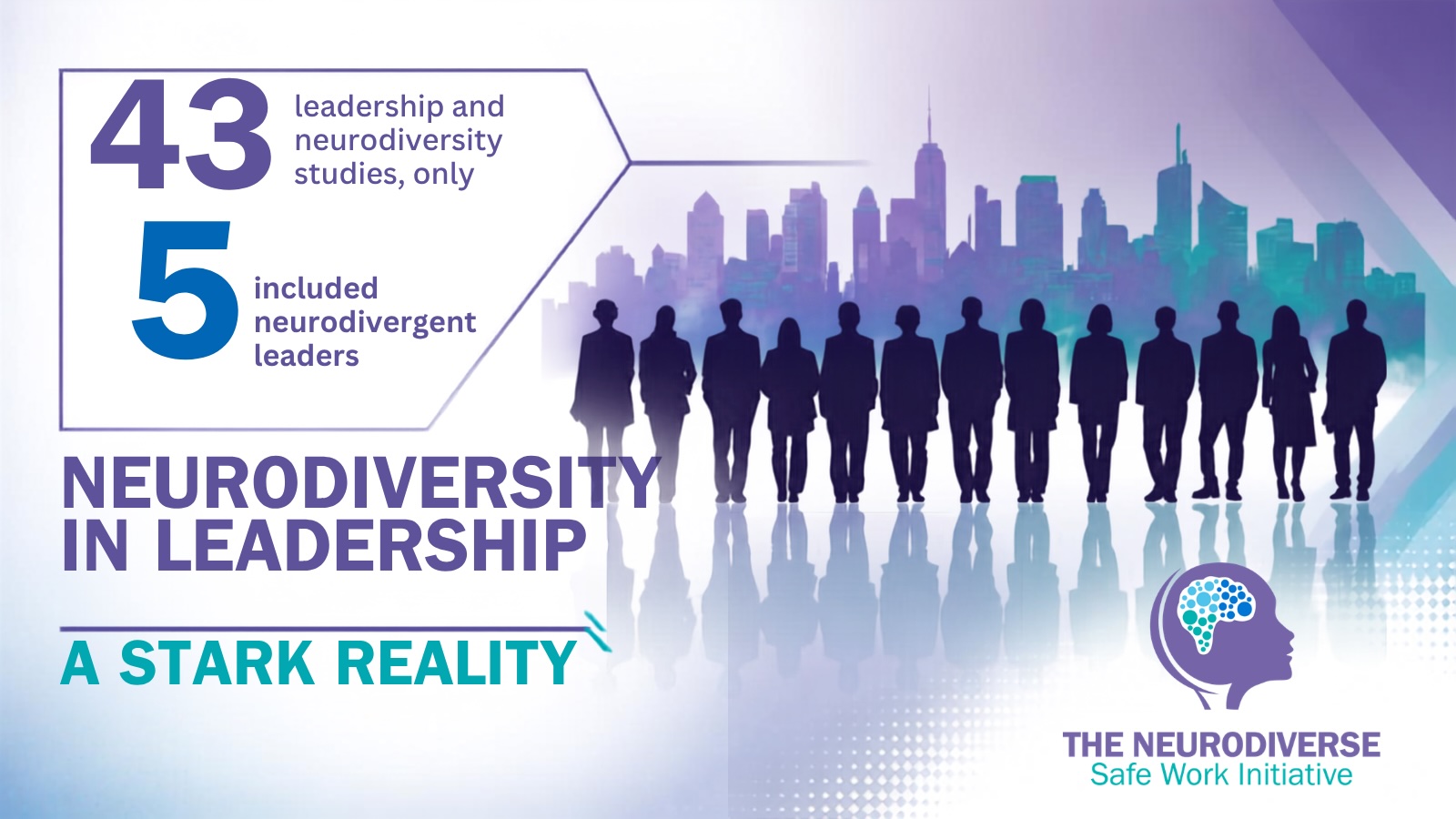
Most neurodiversity and leadership research still examines neurotypical leaders managing neurodivergent followers.That is remarkable given the size of the leadership literature and growing international interest in workplace neurodiversity. The dominant question has therefore remained “How do we lead neurodivergent people?”. Far less attention has been paid to the question “How do neurodivergent people lead?”.
That distinction is relevant, because leadership itself is cognitively demanding work. It requires prioritisation, inhibition, working memory, attention switching, emotional regulation, ambiguity tolerance, planning, communication, relationship management and decision-making, often while under pressure and with incomplete information. It also comes with something ordinary work does not always carry to the same degree.
Power.
A leader’s neurological characteristics do not occur in isolation. They are expressed through a role capable of influencing other people’s workloads, priorities, psychological safety and working conditions. This is where the subject becomes much more interesting than a list of “neurodivergent strengths”.
Forget “strengths versus weaknesses”
The emerging research suggests a different model from the traditionally accepted strengths versus weaknesses (or challenges) response. A neurological characteristic is not inherently a leadership strength or a leadership weakness. Its effect depends upon what the leader is doing, the environment in which they are doing it, the authority attached to their role and the systems surrounding them (Artamoshina et al., 2023; Doyle, 2020; Tran et al., 2026).
Consider ADHD as an example. Research involving 367 CEOs of small and medium enterprises found relationships between CEO ADHD symptoms and business-model innovation under particular conditions, including managerial experience. Other entrepreneurship research has found that hyperactive and impulsive ADHD characteristics can be associated with entrepreneurial orientation and entrepreneurial behaviour ( et al., 2023).
Yet a major recent meta-analysis, drawing on 298 effect sizes from 47 studies, paints a much more complicated picture (Tran et al., 2026). Hyperactivity and impulsivity were positively related to entrepreneurial attitudes and behaviour but were not significantly associated with post-launch outcomes. Inattention was negatively associated with post-launch outcomes. In other words, the characteristics that may help someone start something, are not necessarily the same characteristics that help them sustain it.
That feels immediately recognisable in leadership. Rapid ideation may generate innovation. Rapid ideation may also generate seventeen new organisational priorities before Tuesday. High energy can mobilise a team. High energy can also produce overcommitment. Willingness to act under uncertainty can create entrepreneurial advantage. The same willingness, in another context, can bypass consultation or risk controls. Intense interest may produce exceptional expertise. The same intensity may create a bottleneck when the leader cannot disengage from one issue while everything else waits.
The question then is not “Is ADHD good for leadership?”, it is “Which characteristics are operating, doing what task, under what conditions?”
The same principle applies beyond ADHD. Research and conceptual work on autistic leadership identifies potential contributions around task orientation, logical analysis and detailed processing, alongside potential challenges associated with other aspects of interpersonal and cognitive demand (Williams et al., 2024).
Research with dyslexic entrepreneurs has identified something particularly interesting. Strategies developed to compensate for difficulty, including delegation, may themselves become useful business capabilities (Logan, 2009).
Perhaps some leadership strengths begin life as adaptations. “I cannot be the person who does every part of this job” can eventually become “My role is to find excellent people and allow them to do what they do, better than I can.”
That is not failed independence. That is leadership.
Perhaps neurodivergent leadership is a paradox
We often want characteristics to fit neatly into two columns, strength and weakness. But human beings are considerably less cooperative. We’re messy and complicated. The same characteristic can potentially be an advantage in attaining leadership, an advantage during one particular leadership activity, a liability in another, and personally costly even while producing organisational success.
Take rapid associative thinking for example. In strategy development it may allow a leader to make connections others have missed. During an operational meeting it may mean the conversation moves through seven conceptual leaps while everyone else is still trying to understand the second.
Direct communication is another example. In an organisation drowning in politics and euphemism, directness can be enormously valuable in providing clarity. But directness coming from a colleague and directness coming from the CEO do not always land the same way.
What about novelty seeking? In a stagnant organisation facing disruption, it may be precisely what is required. In a safety-critical operation dependent upon stable procedures and carefully controlled change, unrestrained novelty may be entirely inappropriate.
So perhaps we need a different equation:
Neurocognitive characteristics × task × environment × authority × supports × recovery = leadership impact.
A diagnosis alone tells us relatively little about how someone will lead.
The same neurocognitive characteristic can therefore support or undermine leadership, depending on the circumstances in which it is expressed.
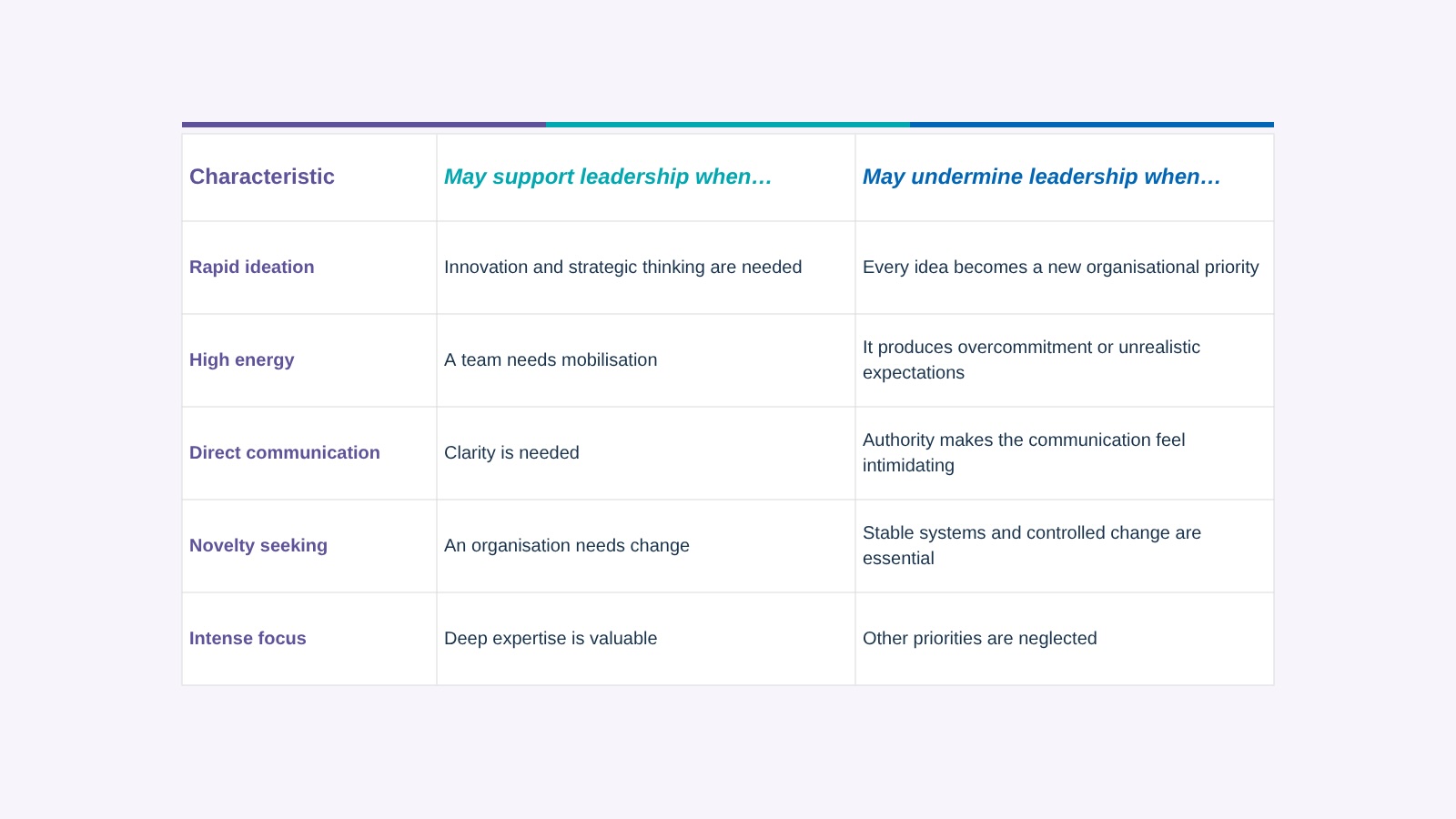
Neurodivergent characteristics are not inherently leadership strengths or weaknesses. Their effects depend on the task, environment, authority, available support and opportunity for recovery.
Authority amplifies behaviour
There is another dimension we rarely discuss. Leadership amplifies characteristics because leaders possess organisational authority.
Imagine an employee who becomes fascinated by a new piece of technology. They may spend several days exploring it. Now imagine the CEO becomes fascinated by it. Suddenly three departments are producing feasibility papers.
That is not ADHD. That is ADHD plus authority.
An employee who generates ideas rapidly may be considered creative. A manager who generates ideas rapidly can unintentionally leave their staff wondering whether each idea represents a new instruction.
A team member who interrupts because they are excited may annoy a colleague. A senior leader who repeatedly interrupts may unintentionally teach an entire executive team that finishing a dissenting argument is unsafe.
An employee who communicates with extreme directness may create some interpersonal friction. A director doing the same thing carries a power differential.
This leads to a principle that applies to every leader, neurodivergent or otherwise. The greater your authority, the more important it becomes to understand the impact of your behaviour rather than relying solely upon your intention. Neurodivergence can explain behaviour. It cannot automatically excuse its consequences.
“I have ADHD” cannot become organisational shorthand for “therefore deadlines don’t apply to me” and “I’m autistic” cannot mean “therefore other people’s response to my communication is irrelevant”. But the alternative cannot be “Senior leaders must therefore suppress every neurologically atypical characteristic and perform neurotypical leadership indefinitely.”
That creates a different problem. Neuroinclusive leadership should require neither neurological conformity nor freedom from accountability. It requires self-knowledge, good systems and reciprocal communication.
When brilliant leadership becomes exhausting leadership
One of the most important questions may not be “Can this person do the job?”. It may be “What does doing the job cost this person?”. This distinction matters. Leadership is visible. The work required to produce that performance often is not.
An autistic executive may be perfectly capable of chairing a complex stakeholder meeting, negotiating sensitively, delivering a presentation and attending a networking function. That tells us the person can perform those activities. It tells us considerably less about the cognitive and physiological effort required to perform them.
Research on autistic camouflaging has documented that autistic adults may consciously or unconsciously modify behaviour to manage social expectations, and that camouflaging can carry significant psychological costs. Leadership can intensify the pressure to do exactly that (Hull et al., 2017; Keenan et al., 2026).
There are expectations about how leaders look. How they speak. How quickly they respond. How much eye contact they make. Whether they attend dinners. How available they appear. Whether they make small talk. How diplomatically they phrase disagreement. Whether they seem calm. Whether they can walk into an unstructured room of strangers and “work the room”.
We need to distinguish between the capacity to perform conventional leadership behaviour and the sustainability of continually performing it.
The same issue appears differently with ADHD. A leader may be extraordinary in meetings, crisis response, strategic thinking and problem-solving while experiencing substantial difficulty with administrative initiation, routine follow-up, paperwork, time estimation or switching from stimulating work to low-stimulation tasks.
From outside, the organisation sees a successful executive. Inside the person’s day, there may be an entirely different story.
Success at work does not tell us what success costs elsewhere
This deserves much more attention. We have a tendency to infer global functioning from occupational status. “She runs a company, so clearly her ADHD can’t be that significant”; “He’s a senior executive. How disabled could he really be?”
But functioning is not a single reservoir distributed evenly across life. A person can be exceptional in one domain and substantially impaired in another. And occupational success may sometimes be achieved by disproportionately allocating cognitive resources to work.
Imagine a senior leader who spends the day making decisions; switching rapidly between issues; managing other people’s emotions; responding to interruptions; remembering commitments; dealing with conflict; controlling their own communication; suppressing sensory discomfort; monitoring how they are being perceived; and holding responsibility for organisational outcomes.
By the time they arrive home, the organisation may have received the best of their executive capacity. The family receives what remains. That may appear as difficulty initiating basic domestic tasks; missed personal appointments; reduced patience; social withdrawal; inability to make another decision; sleep disruption; problems transitioning away from work; unfinished personal administration; or simply needing long periods during which nobody asks anything more of them.
Sometimes another person quietly compensates. A partner remembers appointments, manages household administration, coordinates children, pays bills, organises social commitments, reminds, prompts, recovers forgotten items, protects recovery time.
The leader’s visible occupational performance may therefore be partly supported by invisible executive labour elsewhere. That does not diminish their success. But it should change how we understand it. Achievement is evidence of achievement. It is not evidence of an absence of disability, and success at work does not tell us what that success costs elsewhere.
There is also the question of sleep
One particularly useful ADHD leadership study examined data from 98 leader–follower groups. ADHD symptoms were associated with passive leadership indirectly through daytime sleepiness. That is important. The simplistic interpretation may be “ADHD produces poor leadership.” The research suggests something considerably more useful. There may be an intervening mechanism. Sleep. Now the problem becomes potentially actionable. If a leader’s availability, attention or follow-through deteriorates partly because of daytime sleepiness, then leadership effectiveness is not simply a personality problem (Carleton & Barling, 2018).
Work design, scheduling, recovery and sleep become relevant. This is also a familiar OHS idea. We already know that human performance depends on conditions. Nobody seriously argues that decision-making ability is independent of fatigue, workload, interruptions or sleep. Research on sleep deprivation has long demonstrated effects upon decision-making and team performance (Carleton & Barling, 2018; Harrison & Horne, 2000).
Yet organisational culture routinely celebrates executives working until midnight, answering messages at 5 am and through the weekend and functioning through chronic overload. For some neurodivergent leaders, that may be particularly unsustainable. The question changes from “Can you cope?” to “Have we designed this leadership role to permit reliable human performance?”
Environment matters – including in high-risk decisions
Another particularly interesting study examined decision-making among military leadership candidates with and without ADHD under different conditions. The researchers manipulated the circumstances in which participants made decisions. Decision-making improved under particular interventions, and some face-to-face conditions produced especially strong improvements in participants with ADHD characteristics. The important lesson is not that there is one ideal decision environment for every leader with ADHD. It is that leadership performance changes when the environment changes (Olinover et al., 2022).
This is enormously important in safety-critical industries. We already design systems around human capability with checklists; independent verification, sterile cockpit rules; shift limits; change control; decision authorities; crew resource management; and structured handovers.
We do not regard these systems as evidence that pilots, surgeons, engineers or operators are incompetent. We recognise that excellent people perform more reliably when systems account for predictable human limitations.
Perhaps neurodivergent leadership deserves the same sophistication. The objective should not be to remove every ADHD characteristic from the executive suite. It should be to determine where the leader performs exceptionally well, under what conditions performance deteriorates, and which decisions require friction, consultation or a pause? What should be externalised rather than remembered? Where should another person provide complementary capability?
That is not weakness. That is governance.
Your neurodivergence also enters the relationship
Leadership does not happen inside one person’s brain. It occurs between people. This makes communication particularly important. The neurodiversity literature increasingly challenges the idea that communication problems between autistic and non-autistic people are simply deficits located within the autistic person.
The “double empathy” perspective proposes that misunderstanding can be reciprocal. People with substantially different ways of experiencing and communicating may struggle to accurately interpret each other. Recent neurodiversity-and-leadership scholarship has begun applying that idea to leader–follower relationships.
Now reverse the usual direction. Suppose the leader is neurodivergent. The ADHD manager thinks “I’m brainstorming”. The team hears “Our priorities just changed again”. The manager thinks “I interrupted you because your idea triggered another good idea”. The employee hears “What I was saying wasn’t important”.
The autistic executive thinks “I’m being clear and honest”. The employee thinks “She is angry with me”. The leader thinks “I assumed people would tell me if something wasn’t working”. The team thinks “You are the director. Nobody is going to tell you unless you make it safe”.
Neither party necessarily has malicious intent. But intent alone does not create effective leadership. Shared understanding must be built.
Being neurodivergent does not automatically make you neuroinclusive
This point is uncomfortable but necessary. A neurodivergent leader can create an inaccessible workplace. In fact, leaders frequently design organisations around the way they function best.
An ADHD founder who thrives on speed, spontaneity and constant novelty may create a workplace characterised by rapid pivots, continual messaging, shifting deadlines and frequent interruption. They may find it energising. Someone else may find it disabling.
An autistic leader may value precision, consistency and explicit rules. For some workers, that clarity may be enormously supportive. For others, excessive rigidity may remove necessary autonomy or flexibility.
A dyslexic executive may strongly prefer verbal discussion and delegation over written information. Another worker may desperately need written instructions.
Neurodiversity means exactly that. Human brains differ. It does not mean replacing one compulsory cognitive style with another.
So perhaps one of the most important things a ND leader can learn is this. Do not build the entire organisation around your own nervous system. Build a workplace in which different people have more than one pathway to function well.
When your neurodivergence enters other people’s psychosocial work environment
This is where the conversation becomes particularly relevant to occupational health and safety. Australian employers are now required to identify and manage psychosocial hazards arising from work design, including high job demands, low role clarity, poor support, poorly managed organisational change, conflict and poor workplace relationships (Safe Work Australia, 2022).
Leadership behaviour influences many of these conditions.
Now consider what may happen when an overloaded leader begins to struggle. Rapid shifting of priorities may reduce role clarity. Chronic executive overload may produce delayed decisions and inadequate support. Emotional dysregulation may create unpredictable interpersonal interactions. A leader who works extreme hours may unintentionally establish those hours as the organisational norm. A founder continuously pursuing new ideas may create poorly managed change. A senior manager approaching burnout may withdraw precisely when employees most require access to them.
This does not mean neurodivergent leadership is itself a psychosocial hazard. That would be both inaccurate and discriminatory. It means something much broader. Leader functioning forms part of the system in which other people work. That applies to every leader. For neurodivergent leaders, understanding the interaction between neurocognitive characteristics, workload and authority may therefore be an important part of good organisational risk management.
For more on this, read our article of 7 November 2025 “Psychosocial Risk and Neurodiversity – The Elephant in the Room”.
If you are the neurodivergent leader
So, what do you actually do with all of this? Not every neurodivergent leader requires the same strategies, but several principles follow from the evidence.
- Know your amplification effect – Ask not only “What are my traits?” but also “What happens when this trait has authority attached to it?” Does your enthusiasm become somebody else’s urgent priority? Does your silence cause people to assume something is wrong? Does your preference for immediacy create interruption for everyone else?
Leadership magnifies behaviour. Understand what yours magnifies.
- Separate ideas from instructions – This may be one of the simplest and most valuable practices for rapid thinkers. Say “I’m just brainstorming. Nothing has changed yet.” Or “This is now a decision, and I want it actioned.”
Your team should not have to infer which thoughts matter operationally.
- Externalise executive functioning – Do not build an executive role around remembering everything. Capture your decisions; document priorities; use reminders; create follow-up systems; use executive assistance where appropriate; build predictable decision processes; if a system can reliably remember something for you, your working memory does not have to.
- Build complementary leadership – Exceptional leadership does not require being exceptional at every element of leadership. Your COO, deputy, executive assistant, chief of staff, fellow director or trusted manager may possess exactly the cognitive strengths you do not. Complementarity is not evidence of inadequacy. It is one reason organisations have leadership teams rather than leadership superheroes.
- Learn your overload signature – What changes first when you are approaching cognitive saturation? Do you become abrupt? Withdraw? Start missing follow-ups? Talk faster? Become rigid? Lose tolerance for interruption? Make increasingly rapid decisions? Avoid decisions entirely? Your team may detect your overload before you consciously recognise it. That information is valuable.
- Give people permission to clarify you – Do not simply announce that your door is open. Say explicitly “If I start generating ideas and you’re unsure whether something is a decision, ask me.” Or “If my communication seems unusually abrupt, check what I intended.” Or “If priorities conflict, I want you to tell me.”
Authority makes clarification harder. Leaders need to make it safer.
- Put friction around your predictable risk points – Not every decision should occur at the speed your brain is capable of making it. Some decisions warrant a second reviewer; a cooling-off period; written criteria; consultation; risk assessment; or deliberately sleeping on it.
Good governance frequently consists of strategically slowing good people down.
- Protect recovery as part of leadership performance – Recovery is not a reward given after all work has finally been completed. For many leadership roles, there will always be more work. If reliable decision-making depends upon cognitive capacity, then sleep and recovery belong in the performance system.
- Look outside work – Ask yourself “What is my occupational success costing elsewhere?” Who is carrying the administrative load that allows me to perform? What happens to me after a week of high social demand? What does my family experience during periods of executive overload? Can I recover sufficiently to live a life beyond my position?
These are not merely personal wellbeing questions. They are questions about the sustainability of your leadership model.
Not despite. Not automatically because. But inseparable from.
There is something appealing about stories of extraordinary neurodivergent entrepreneurs and executives and those who I coach inspire me every day. They offer an antidote to decades of deficit-focused language.
But we should resist replacing one stereotype with another. ADHD is not automatically a superpower. Autism does not automatically produce exceptional analytical leadership. Dyslexia does not automatically make someone entrepreneurial. The brilliance that comes with these neurotypes does not cancel out the challenges.
And successful neurodivergent leaders are not successful simply because they have somehow defeated their neurology. The evidence points toward something more complex and, I think, more hopeful. Some characteristics associated with neurodivergence may contribute meaningfully to innovation, entrepreneurial behaviour, task-focused leadership, unconventional problem-solving or other valuable forms of performance.
The same person may simultaneously experience genuine executive-dysfunction and communication, sensory, emotional or organisational difficulty.
Both things can be true. A leader can be brilliant and need support. Innovative and inconsistent. Decisive and vulnerable to impulsivity. Deeply empathic and socially exhausted. Highly successful and disabled.
These are not contradictions. They are human complexity.
Perhaps the goal for a neurodivergent leader is therefore not to become indistinguishable from a neurotypical one. Nor is it to declare every neurological characteristic an advantage. It is to understand their own cognitive operating system well enough to ask when should I trust this? When should I support it? When should I slow it down? When should somebody else take the lead? And what environment allows me to lead well without using every available resource simply to appear as though leadership comes naturally?
Because perhaps the best neurodivergent leadership does not occur despite neurological difference. Nor automatically because of it. It emerges when difference is understood, supported, governed and allowed to contribute.
That may be a leadership lesson worth learning regardless of neurotype.
Research cited in this article
Artamoshina, P., Shirokova, G., Osiyevskyy, O., & Bodolica, V. (2023). ADHD symptoms of CEOs and business model innovation in the SME context. Technovation, 128, 102845. https://doi.org/10.1016/j.technovation.2023.102845
Carleton, E. L., & Barling, J. (2018). Adult attention deficit hyperactivity disorder symptoms and passive leadership: The mediating role of daytime sleepiness. Stress and Health, 34(5), 663–673. https://doi.org/10.1002/smi.2833
Doyle, N. (2020). Neurodiversity at work: A biopsychosocial model and the impact on working adults. British Medical Bulletin, 135(1), 108–125. https://doi.org/10.1093/bmb/ldaa021
Harrison, Y., & Horne, J. A. (2000). The impact of sleep deprivation on decision making: A review. Journal of Experimental Psychology: Applied, 6(3), 236–249. https://doi.org/10.1037/1076-898X.6.3.236
Hull, L., Petrides, K. V., Allison, C., Smith, P., Baron-Cohen, S., Lai, M.-C., & Mandy, W. (2017). “Putting on My Best Normal”: Social Camouflaging in Adults with Autism Spectrum Conditions. Journal of Autism and Developmental Disorders, 47(8), 2519–2534. https://doi.org/10.1007/s10803-017-3166-5
Keenan, J., Doherty, M., & Shaw, S. C. K. (2026). The Experiences of Autistic Doctors Transitioning into Clinical Practice in the UK: A Phenomenological Study. Teaching and Learning in Medicine, 1–15. https://doi.org/10.1080/10401334.2025.2608185
Kirkwood, M., Radcliffe, L., Lyubovnikova, J., & Otaye‐Ebede, L. (2025). Advancing a relational perspective on leadership between neurotypical leaders and neurodivergent followers: An integrated systematic review and research agenda. International Journal of Management Reviews, e70008. https://doi.org/10.1111/ijmr.70008
Logan, J. (2009). Dyslexic entrepreneurs: The incidence; their coping strategies and their business skills. Dyslexia, 15(4), 328–346. https://doi.org/10.1002/dys.388
Olinover, M., Gidron, M., Yarmolovsky, J., & Geva, R. (2022). Strategies for improving decision making of leaders with ADHD and without ADHD in combat military context. The Leadership Quarterly, 33(6), 101575. https://doi.org/10.1016/j.leaqua.2021.101575
Safe Work Australia. (2022). Model Code of Practice: Managing psychosocial hazards at work. https://www.safeworkaustralia.gov.au/sites/default/files/2022-08/model_code_of_practice_-_managing_psychosocial_hazards_at_work_25082022_0.pdf
Tran, M. H., Wiklund, J., Antshel, K., Jhawar, N., & Montgomery, C. (2026). Entrepreneurship and ADHD: A Meta-Analytical Assessment of the State-of-the-Art and Suggestions for the Future. Entrepreneurship Theory and Practice, 50(3), 789–829. https://doi.org/10.1177/10422587251392498
Williams, N., Bragger, J., & Myszko, Z. (2024). (Neuro)Diversifying organizations: The case for developing autistic leaders. Consulting Psychology Journal, 76(1), 1–19. https://doi.org/10.1037/cpb0000272