Where Reasonable Adjustments End and Risk Management Begins
Reasonable adjustments and workplace risk management are often treated as two distinct workplace processes. Reasonable adjustments are commonly understood as measures that enable a person with disability to perform the essential requirements of their role, usually supported by disclosure, diagnosis and evidence of need. Risk management, by contrast, is concerned with identifying and controlling risks arising from work that may cause harm. The problem is that if a neurodivergent worker cannot satisfy the evidentiary requirements for reasonable adjustments, the process usually stops there. The worker may continue to struggle, but their difficulties are not then examined through a risk management lens, even where the underlying issue is plainly one of unmanaged risk. This distinction is not merely theoretical; it has practical consequences for how workers experience safety, support, and inclusion. This article illustrates how the application of the medical model of disability, when used as the primary gateway to workplace change, can inadvertently prevent risks from being addressed. It argues that the central issue is not unequal treatment in intent, but the failure to recognise that both situations required the same response, the proactive control of risks arising from work design.
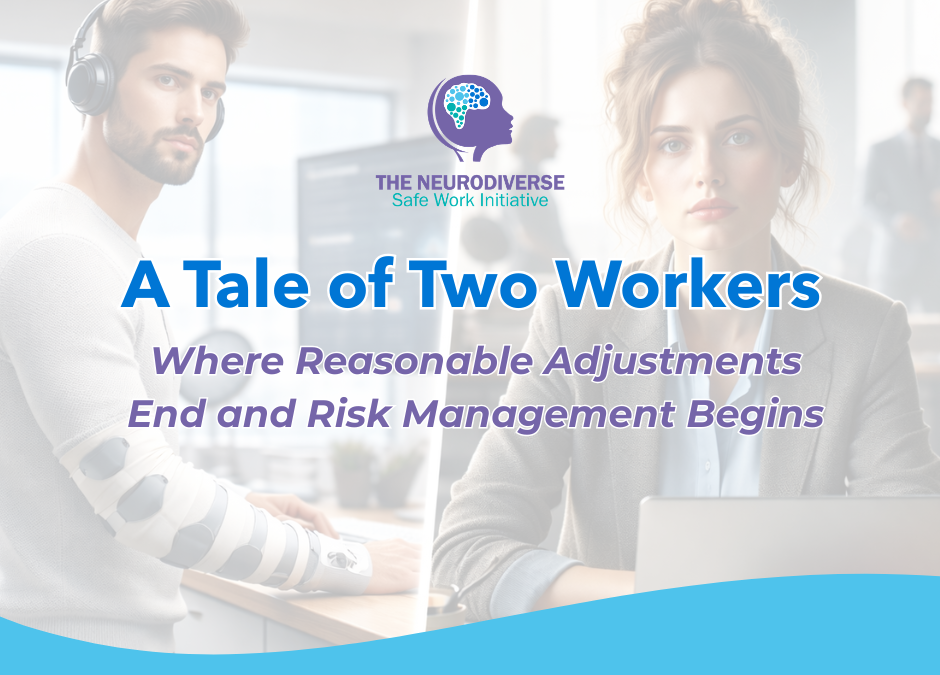
A Tale of Two Workers
Jim – Intervention Through the Medical Model
Jim is recovering from work-related upper limb injuries. His condition has been formally diagnosed, medical certification provided, and his statutory workers’ compensation claim has been accepted. His injuries are such that he would struggle to perform the essential requirements of his role without the adjustments. The inherent design of his role creates a risk of exacerbation and long-term impairment if adjustments are not made. Jim’s doctor has advised of the necessary medical restrictions, and his physiotherapist has recommended a range of modifications to his work to support recovery and prevent further harm. These include:
- A sit-stand workstation

- Ergonomic peripherals
- Scheduled micro breaks
- Voice-to-text software
- Automated note-taking
- Modified task structuring
The organisational response is immediate and unambiguous. The recommended modifications are implemented without question or delay, as they are understood to be necessary to reduce the risk of exacerbation and long-term impairment. In this context, the presence of medical evidence provides a clear justification for action, and the risks associated with Jim’s work are actively controlled.
Sarah – The Same Model Fails
Sarah works in the same team as Jim and performs comparable duties. She is experienced, capable and has a strong history of high performance.
She identifies as an AuDHD person with Dyslexia. Her neurodivergent profile is not a deficit, but a source of capability. It contributes to her creativity, pattern recognition and capacity to engage deeply with complex work. However, the design of her role places heavy demands on sustained reading, writing, information processing and concentration in a busy office environment. While she is able to do the work, doing so requires substantial and sustained cognitive effort.
Like Jim, Sarah identifies a number of practical measures that would enable her to work more safely and sustainably. These include:
- accessibility features activated on her computer
- access to a quiet space
- flexible work hours

- scheduled micro breaks
- voice-to-text software
- automated note-taking tools
- clear task prioritisation and communication
Unlike Jim, Sarah is unable to produce the evidence the organisation requires to justify these changes. Her diagnostic assessments were completed during childhood and are now considered outdated. Current diagnostic pathways are costly, slow and inaccessible in the short term.
At this point, the reasonable adjustments process comes to an end. Because Sarah cannot meet the evidentiary threshold, her requests are declined and no changes are made to her work.
This is where the problem emerges.
The absence of current medical evidence does not mean the risks associated with Sarah’s work are absent. Nor does it mean the controls she identified are unnecessary. It simply means she cannot access them through the reasonable adjustments framework.
Rather than asking whether the same issues should now be considered through a work health and safety lens, the organisation treats the matter as closed.
Sarah continues to work in an environment that creates excessive cognitive load, fatigue and increasing difficulty sustaining performance. Over time, what began as a manageable challenge becomes more pronounced, not because of any lack of skill, effort or motivation, but because the underlying risks associated with the design of her work remain unaddressed.
Her performance begins to decline, and an issue that should have been identified and managed as a workplace risk is instead reframed as an individual performance problem.
Same Needs, Same Risks, Different Outcomes
At their core, both Jim and Sarah required the same thing. A reduction in the risks to them associated with the work design. The controls requested in both cases were not extraordinary or burdensome. They would not create unjustifiable hardship for the employer. They are practical, achievable, and demonstrably feasible within the organisation, as evidenced by their implementation in Jim’s case. The difference in outcome did not arise because the risks were different, nor because the controls were unavailable. It arose because the organisation relied on the medical model of disability as the mechanism for determining whether those controls would be implemented. In Jim’s case, the existence of medical evidence made the risks visible and actionable. In Sarah’s case, the absence of such evidence rendered those same risks effectively invisible, despite their presence.
Risk Perception and the Nature of Harm
A critical factor in understanding this disparity is the subjective nature of risk perception. Just as pain is experienced differently by individuals, so too is the impact of work design. A task or environment that appears manageable or even benign to one worker may present a significant risk to another. In Sarah’s case, the psychosocial risks associated with cognitive overload, sensory stimulation, and unclear task structures are real, even if they are not immediately visible to others. Her neurodivergent profile shapes how these risks are experienced, in the same way that Jim’s injury shapes his experience of physically demanding keyboard-heavy work. The absence of visible harm or shared perception does not negate the existence of risk. It simply reflects variation in how that risk is experienced. Under WHS principles, this variation must be anticipated and addressed.
The Role and Limitations of the Medical Model
The medical model of disability plays an important role in workplace systems, particularly in the context of disability employment, injury management and compensation. It provides a structured process through which medical conditions, injuries and disabilities are diagnosed and treated, how evidence is gathered and used, and how adjustments provided. However, the model is inherently reactive. It requires the identification and disclosure of a condition before any action is taken. When applied as the primary framework for workplace change, it assumes that risks must first be validated through diagnosis before they can be addressed. This assumption is not consistent with the principles of work health and safety.
WHS Obligations – A Proactive Duty of Care
Under WHS legislation, employers have a primary duty to ensure, so far as is reasonably practicable, that work is designed and performed in a way that is safe. This duty extends to both physical and psychological health and applies to all workers, regardless of whether they have disclosed a condition or provided medical evidence. Importantly, the WHS framework does not require workers to demonstrate a personal need for risks to be controlled, before controls are implemented. It requires organisations to proactively identify hazards, assess risks, and implement appropriate controls. This means that if a risk exists, whether it is physical, cognitive, or psychosocial, it must be addressed. The obligation is not triggered by diagnosis, it is triggered by the presence of risk. This distinction is critical. It shifts the responsibility from the individual to prove their need for risks to be controlled, to the system. It recognises that risks exist independently of diagnosis and that effective control measures should be applied, wherever those risks are identified, even if those risks are not seen and perceived by others in the same way.
Risk Management in Practice – What Should Have Happened
If both Jim’s and Sarah’s situations had been approached through a risk management lens, the process would have begun with an examination of the work itself. The organisation would have, in consultation with the workers doing the work, identified hazards such as high cognitive demand, unclear task structures, heavy reliance on text and keyboards and environmental distractions.
It would then have assessed the risks associated with these hazards, including fatigue, reduced concentration, increased error rates, and psychological and/or physical strain. From this assessment, risk control measures would have been identified and implemented. These may have included adjustments to work design, such as clearer task prioritisation and communication, as well as environmental modifications to reduce noise and distraction.
Assistive technologies, such as voice-to-text and automated note-taking tools and the activation of accessibility features on computers, could have been introduced as standard supports designed into the system of work, rather than individual adjustments.
Structured breaks and flexible work arrangements could have been incorporated to manage sustained cognitive and physical demands. Crucially, these risk controls would not have been contingent on either worker providing medical evidence of the need. They would have been implemented because they were necessary to reduce identified risks, not just for Jim and Sarah, but for all workers doing that work, if they need them.
When Adjustments Are Misclassified
A central issue highlighted in this article is the misclassification of risk management controls as “reasonable adjustments”. When measures that address known hazards are treated as discretionary individual accommodations, access to them becomes conditional. This creates inconsistency and delays and allows risks to persist unnecessarily. In reality, many of the reasonable adjustments commonly requested by neurodivergent workers, particularly those relating to cognitive load, communication clarity, and environmental conditions, are well-established cognitive and psychosocial risk management controls. They align with principles of good work design and benefit all workers not just those with recognised or diagnosed medical conditions, neurodivergence or disabilities.
Beyond Discrimination
While Sarah’s experience may appear, at first glance, to be an issue of discrimination, the more precise problem lies in the misapplication of frameworks. The organisation did not refuse her request out of bias, but because it applied a model that was not suited to the situation. By relying on the medical model, the organisation made the reduction of risk contingent on proof of diagnosis. This approach obscured its primary duty under WHS law and resulted in a failure to manage known risks, which resulted in psychological harm.
A Final Reflection
The contrast between Jim and Sarah does not illustrate a difference in need, but a difference in how those needs were interpreted. In both cases, the underlying issue was the same. There were hazards created by the design of their work that they experienced differently from other workers, because of their unique characteristics. In Jim’s case, the proven medical diagnosis gave the employer the evidence it needed to identify the hazards, assess the risks and implement controls to reduce the risk. In Sarah’s case, where the medical model is so heavily relied upon, the absence of evidence, gave the employer cause to doubt that the risk was real and that controls were necessary. So, they did nothing, and the risk remained and accelerated. This raises an important question for employers. If a risk management control is necessary to reduce risk, why should its implementation depend on a worker’s ability to prove that need? Under the WHS framework, it should not. Effective risk management requires organisations to act proactively, to consult with workers in designing work that is safe. It requires employers consider workers with differing needs and vulnerabilities and factor these into the risk management process. When these principles are applied consistently, fewer workers experience “disablement” because of the systemic barriers in their environment. They don’t need to ask for adjustments or prove the need, because risk management controls are designed into the system by default. The work systems, culture and environment become inherently safer, more inclusive, and more sustainable for all workers.
Conclusion
A Tale of Two Workers ultimately reveals a critical gap between policy and practice. When organisations rely on the medical model and disability discrimination frameworks too heavily, they risk overlooking their broader obligations under WHS law to manage risk. By reframing “reasonable adjustments” as “risk management controls” and prioritising proactive, inclusive and safe work design, employers can more effectively discharge their primary duty of care to ensure the safety of all workers, not just those who can prove they may be harmed if risk is unmanaged.
If your organisation is reviewing how it manages psychosocial risk, workplace adjustments or neuroinclusion, contact us to learn more about our services an to discuss how your organisation can implement neuroinclusive risk management practices.