One of the questions I am asked most often when I speak with employers about neurodiversity is, “What do you think about workplace neurodiversity screening?” It comes up in workshops, presentations, training courses and conversations with safety and HR professionals.
Usually, there is a practical concern behind the question. A worker is having difficulty with some aspect of their job, and the employer wants to understand what would help. The worker may suspect they have ADHD or are autistic, dyslexic or dyspraxic. They may have a childhood report that says little about their current work, or no diagnosis at all.
My answer depends on what the employer hopes screening will achieve. A credible tool can help someone make sense of their experiences and explore support. Problems arise when a questionnaire becomes a shortcut for deciding what is wrong with a worker, whether they are capable, or whether they deserve an adjustment.
These conversations prompted me to develop Adult Neurodiversity Screening Tools: Evidence & Resource Guide for Employers. The Guide brings together information about the tools, their evidence and limitations, and the safeguards needed when they are discussed in employment.
Understanding The Workplace Difficulty
Many neurodivergent adults reach employment without a formal diagnosis. Assessment may be difficult to access because of cost, waiting times or a shortage of suitable services. A childhood diagnosis may remain relevant, but the accompanying report was written for a different stage of life and often an educational setting. It may not explain the demands the person encounters at work today.
An employer does not need to resolve every clinical question before examining a workplace barrier. A worker might be confident in the technical aspects of their role yet struggle when instructions arrive verbally, several people speak at once, or priorities change without explanation. The useful starting point is to ask what happens during the task and what would make it easier to carry out safely.
For example, a worker might regularly miss part of a verbal handover in a busy workshop. Before interpreting this as carelessness, a manager could ask how the worker receives information, observe the noise and interruptions, and trial a written handover with an opportunity to confirm priorities. The changes would need to suit the task and its safety requirements, but the conversation can begin without a screening score.
Research on neurodiversity at work emphasises the interaction between the person and their environment (Doyle, 2020). Safe Work Australia’s good work design principles similarly address cognitive and psychosocial demands alongside the needs and capabilities of the people doing the work (Safe Work Australia, 2015).
This is why I approach neuroinclusion through human factors, risk management and work design. Individual reasonable adjustments remain important. They complement the preventive work of making instructions accessible, managing unnecessary sensory demands and consulting workers about how work is organised. Diagnosis and disclosure can inform support, but an organisation can improve its systems before someone makes an individual request.
Choosing a tool for the question
A screening questionnaire can indicate that a pattern of symptoms or traits warrants further exploration. It cannot, by itself, establish a diagnosis or determine whether a person is competent or fit for a particular job. The Australian ADHD guideline highlights the limits of screening accuracy and recommends further assessment following a positive ADHD screen (Australian ADHD Professionals Association [AADPA], 2022).
The tools in the Guide serve different purposes. A brief ADHD screener may help someone decide whether to seek assessment. An autism referral tool addresses another question. The Camouflaging Autistic Traits Questionnaire (CAT-Q) explores strategies people use to compensate for or mask autistic characteristics during social interactions. It was developed for autistic and non-autistic adults and is not an autism diagnostic test (Hull et al., 2019).
The Guide also covers reading-history and dyslexia questionnaires, adult developmental coordination disorder or dyspraxia screening, obsessive-compulsive symptoms and tic severity. These measures should not be treated as interchangeable “neurodiversity tests”. A tic severity questionnaire, for example, measures a different issue from a tool intended to prompt diagnostic assessment.
The Neurodiversity Workplace Profiler focuses on workplace strengths, barriers and support needs. It can help structure a conversation about communication, sensory demands, attention and supervision; it does not establish a clinical diagnosis. The Guide explains its evidence limitations and identifies adult dyscalculia and dysgraphia self-screening resources for which comparable peer-reviewed validation evidence was not found.
Research findings also need context. Strong performance in a specialist clinical sample does not guarantee the same accuracy in a general workforce. A positive result is a reason to explore further; a negative result may still leave important questions unanswered (AADPA, 2022).
Before Recommending An Online Test
Free online questionnaires can be appealing, particularly to someone who has spent years trying to understand why ordinary tasks take so much effort. A colourful profile or a result labelled “severe” may feel like an explanation at last. That makes it important to know what sits behind the score before recommending the test to a worker.
While preparing the Guide, I tried a free website advertising a five-minute questionnaire covering 13 forms of neurodivergence. Some of my strongest results related to learning profiles that did not fit my lived experience or clinical assessments. One attempt cannot tell us how accurate a tool is overall. It did, however, leave me wanting to understand how those results had been calculated.
The site subsequently added an About page, privacy information and clearer statements that the quiz was for reflection rather than diagnosis. Those were useful improvements. However, as of 9 October 2026, I still could not locate an identified developer, published validation evidence or scoring rules explaining its results and optional age and gender adjustments. Without that information, I could not judge how much confidence to place in the report.
Broad questionnaires raise another question. How do they distinguish overlapping experiences? Difficulty concentrating, for example, can occur with ADHD, anxiety, sleep problems or stress. A tool needs evidence that it can distinguish what it claims to measure. Several high scores do not necessarily mean that a person has several conditions (AADPA, 2022).
Before suggesting a questionnaire, I would look for a named developer or responsible organisation, a clear intended audience, published research and an explanation of scoring and limitations. A precise percentage is of little help if the user cannot find out what it represents. Contact details should also work when someone asks a reasonable question about the methodology.
I would pay particular attention to what appears beside the result. Advertising and affiliate funding are not inherently improper, but a recommendation for a paid service should explain any commercial relationship clearly. A tracked referral link alone does not establish that payment occurred or that a provider endorsed the quiz. It does give the reader a reason to ask who may benefit from the referral.
Privacy also deserves more than a quick check for a request for a name or email address. IP addresses can be personal information where a person is identifiable in the circumstances (Office of the Australian Information Commissioner, n.d.). Even if answers stay in a browser, users should be able to understand any analytics, advertising or referral tracking and who receives that information. For young workers and apprentices, I would also look for age-appropriate explanations and a clear support pathway if a result causes concern.
If a worker brings a concerning result to a manager, the response should leave room for discussion. Ask what resonated with them and what they are finding difficult at work. They should not feel pressured to accept a label or buy a service because a website produced a high score. Persistent concerns can be discussed with an appropriately qualified health professional.
Keeping Screening Voluntary and Useful
I recommend a worker-led approach. The employer can provide reliable information and explain available options. The worker decides whether to complete a questionnaire and whether to share any results. Declining screening should not prevent a conversation about work barriers or support.
JobAccess encourages employers to discuss the functional effects of disability and the changes that would help, rather than defaulting to requests for medical proof or diagnosis (JobAccess, 2025). Where safety or the requirements of a role raise specific concerns, employers may need appropriate functional information and professional advice. An online score cannot answer those questions for them.
The Guide sets out a practical pathway, from identifying the work difficulty through to reviewing whether changes help (Figure 1).
If a worker chooses to share a report, agree on its purpose, who needs access and how it will be handled. Collect only the information needed for that purpose and protect its confidentiality. Managers generally need to understand what will help the person work safely, rather than collect their questionnaire responses.
Screening results should not be used to select or exclude applicants, determine promotion or disciplinary outcomes, decide fitness for work, or judge whether support is deserved. Mandatory workforce screening is also inappropriate. Australian ADHD guidance does not recommend routine population screening for ADHD; offering a voluntary option to an interested person is a different decision (AADPA, 2022).
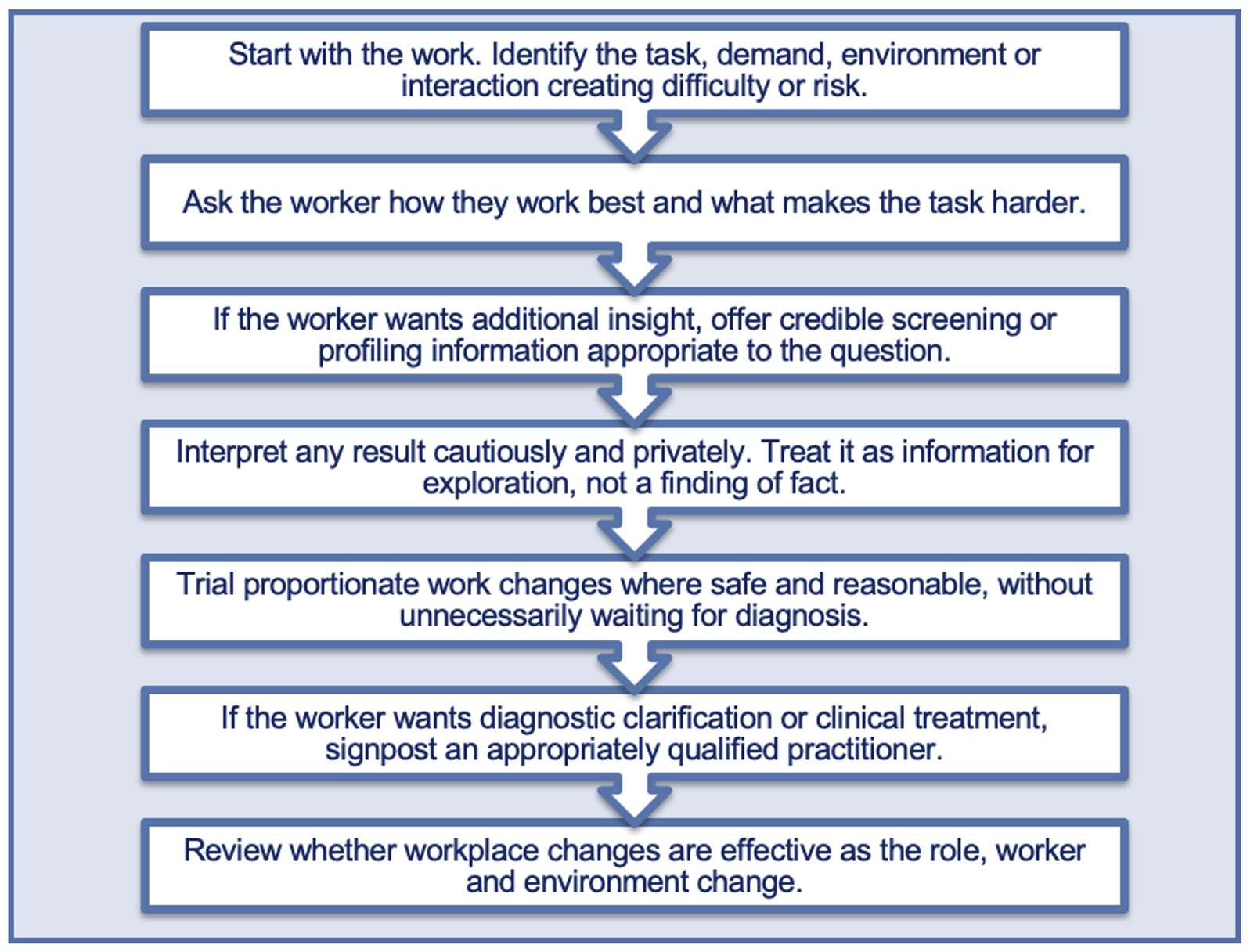
Figure 1. Start with the work, not a diagnosis: a practical pathway for identifying workplace barriers, exploring reasonable adjustments and considering voluntary neurodiversity screening where appropriate.
The Guide and the forthcoming workshop
Adult Neurodiversity Screening Tools: Evidence & Resource Guide for Employers is intended for employers, safety and HR professionals, occupational health practitioners and managers. It explains the purposes and limitations of the tools, provides source links, and considers how screening information can contribute to responsible workplace support.
I will follow its release with a practical workshop early in 2027. We will examine the tools in more detail, interpret what their evidence and scores mean, and discuss how to respond when a worker brings a screening result to an employer.
The workshop will also explore how to turn information into proportionate work changes and review whether those changes are effective. The question I want employers to leave with is one they can use immediately: “What does this worker need to do their work safely, sustainably and well?” Further workshop details will be announced in the new year.
References
Australian ADHD Professionals Association. (2022). Australian evidence-based clinical practice guideline for attention deficit hyperactivity disorder. https://adhdguideline.aadpa.com.au/
Doyle, N. (2020). Neurodiversity at work: A biopsychosocial model and the impact on working adults. British Medical Bulletin, 135(1), 108–125. https://doi.org/10.1093/bmb/ldaa021
Hull, L., Mandy, W., Lai, M.-C., Baron-Cohen, S., Allison, C., Smith, P., & Petrides, K. V. (2019). Development and validation of the Camouflaging Autistic Traits Questionnaire (CAT-Q). Journal of Autism and Developmental Disorders, 49(3), 819–833. https://doi.org/10.1007/s10803-018-3792-6
JobAccess. (2025, February 24). What employers ask as evidence of disability from employees. https://www.jobaccess.gov.au/news/evidence-disability
Lee, C. (2026). Adult neurodiversity screening tools: Evidence & resource guide for employers [Unpublished manuscript]. The Neurodiverse Safe Work Initiative.
Office of the Australian Information Commissioner. (n.d.). What is personal information? https://www.oaic.gov.au/privacy/your-privacy-rights/your-personal-information/what-is-personal-information
Safe Work Australia. (2015). Principles of good work design: A work health and safety handbook. https://www.safeworkaustralia.gov.au/system/files/documents/1702/good-work-design-handbook.pdf