Attention Deficit Disorder Association Webinar

by | Nov 13, 2025

Webinar Host: Attention Deficit Disorder Association

Every employer knows that if a job candidate or employee discloses that they have a disability, then the employer must make reasonable adjustments to help them perform in the job. So if someone says they have ADHD you just give them a pair of noise-cancelling headphones, right? Because that’s what we did for the last guy with ADHD and he was happy with that.

But what happens if the disability is a mental health or neurodivergent condition, such as ADHD and the candidate or employee does not tell their employer?What happens if the candidate or employee does not know they have ADHD? What if the candidate or employee knows they have ADHD but does not consider it to be a disability as far as their work is concerned? Most adults with ADHD do not disclose their condition to their employer because they either fear discrimination and judgement or because they do not believe it affects their work performance and so they should not have to disclose their own personal medical information. And who can blame them?

Much of the current advice provided to adults with ADHD in relation to telling their employer is:
1) Here are some tips and tricks about how you can perform effectively at work; and
2) Here are the pros and cons of disclosing to your employer. But think carefully about it. It’s probably best not to if you think you don’t think your employer will be accomodating.


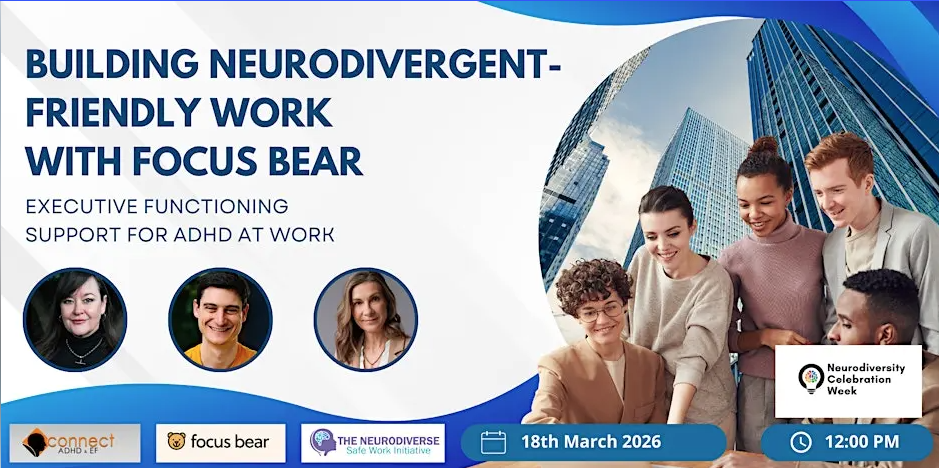
Building Neurodivergent Friendly Work with FocusBear

Building Neurodivergent Friendly Work with FocusBear

Workplaces are often designed with an unspoken assumption: that everyone can manage time, attention, memory and task initiation in the same way. For many neurodivergent workers—particularly those with ADHD—this creates a hidden layer of risk.

In this webinar, you will learn how executive functioning demands built into everyday work design can increase cognitive load, contribute to burnout, and be misinterpreted as poor performance or non-compliance. More importantly, you will gain practical, system-based strategies to redesign work so that it supports how people actually think and function.

Featuring Focus Bear, this session demonstrates how simple tools and structured workflows can scaffold executive functioning, improve consistency, and reduce psychosocial risk, without placing the burden on the individual.