ADHD Tax: Why Money Systems Fail Neurodivergent Brains and What Actually Helps
Watch this complimentary webinar exploring ADHD Tax, neurodivergent money management and the practical systems that can make managing money easier.
Presented by Catherine Lee from the Neurodiverse Safe Work Initiative and Certified Financial Planner Phil Toop.
About the webinar
Have you ever forgotten to pay a bill, been charged for a subscription you no longer use, paid an unnecessary late fee or made an impulse purchase you later regretted?
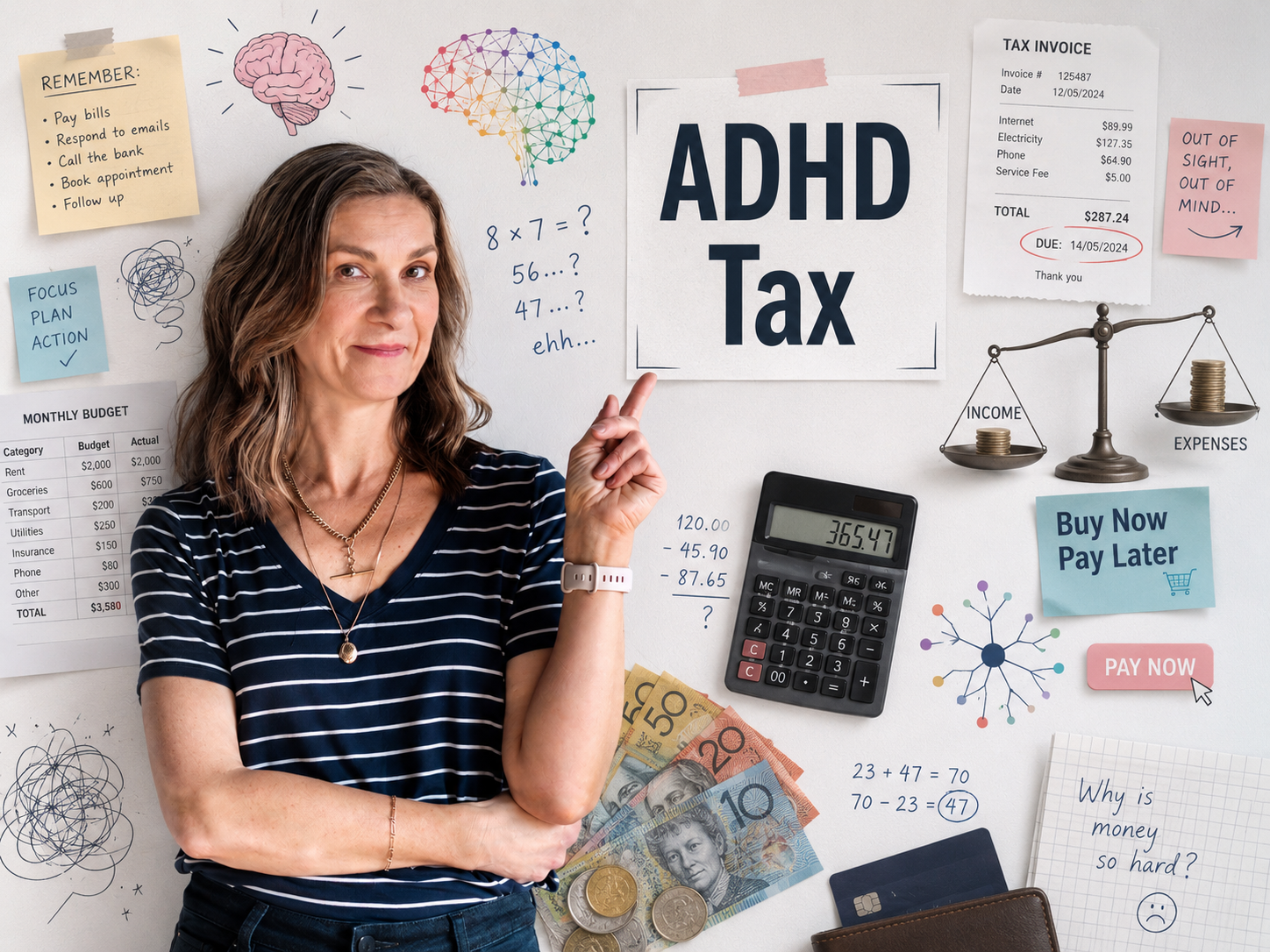
These seemingly small financial costs can accumulate over time. Within the ADHD and broader neurodivergent community, they are often referred to as ADHD Tax.
ADHD Tax is not simply the result of being careless or “bad with money”. Everyday financial management frequently depends on planning, memory, organisation, task initiation, time awareness, impulse regulation and numerical processing. These demands can create additional barriers for people with ADHD, dyscalculia and other forms of neurodivergence.
In this recorded webinar, Catherine Lee and Phil Toop explore why conventional money-management systems do not work equally well for every brain. They consider how better-designed systems can reduce cognitive load, financial stress and shame, and support greater financial confidence.
What you will learn
In this webinar, Catherine and Phil discuss:
- What ADHD Tax is and why it occurs
- How ADHD, dyscalculia and executive functioning can affect money management
- Why conventional budgeting and financial-management advice may not work for neurodivergent people
- How cognitive load, time perception, impulsivity and task-initiation difficulties can contribute to financial stress
- Practical ways to automate, simplify and structure financial tasks
- How flexible, strengths-based systems can support financial wellbeing
- Why difficulties managing personal finances should not be mistaken for a lack of professional competence or trustworthiness
A different approach to neurodivergent money management
This webinar moves away from the idea that people need to try harder, become more disciplined or force themselves to follow systems that have repeatedly failed them.
Instead, it asks a more useful question:
How can we design financial systems that work with different ways of thinking, remembering, organising and processing information?
The strategies discussed include reducing unnecessary decisions, automating routine tasks, creating clearer visual structures, using reminders and accountability, and developing systems that require less ongoing attention.
Phil also introduces the thinking behind NeuroMoney, an approach he has developed to make financial management more accessible and responsive to the needs of neurodivergent people.
Who is this webinar for?
This webinar may be helpful for:
- Neurodivergent adults
- People with ADHD or dyscalculia
- Parents, partners, carers and supporters
- Financial advisers, coaches and counsellors
- Employers and business owners
- HR and WHS professionals
- Managers and team leaders
- Anyone interested in neurodiversity and financial wellbeing
You do not need a formal diagnosis or any prior financial knowledge to benefit from the session.
Meet the presenters
Catherine Lee
Catherine Lee is the Founder of the Neurodiverse Safe Work Initiative and Director of Lethbridge Piper & Associates. She has more than 30 years’ experience helping organisations create healthier, safer and more inclusive workplaces through better work design and neurodiversity-informed practice.
Catherine combines professional expertise in occupational health and safety, management consulting and coaching with lived experience of ADHD. Her work focuses on shifting attention away from perceived individual deficits and towards the design of systems, environments and work practices.
Phil Toop
Phil Toop is a Certified Financial Planner, CFA Charterholder®, CAIA® and ABFP®, with more than 30 years’ experience in financial services. He is Co-Founder and Managing Director of Dorset Wealth Management and brings lived experience as an AuDHD professional.
Phil has developed the NeuroMoney approach to explore how financial systems and professional support can better meet the needs of neurodivergent people. His work combines extensive expertise in financial planning and wealth management with practical, strengths-based approaches to reducing financial complexity.
Why this conversation matters
Financial difficulties are often interpreted as evidence of irresponsibility, poor judgement or a lack of self-discipline. That interpretation overlooks the extent to which money management depends on cognitive processes that vary considerably between people.
Recognising these differences does not remove personal responsibility. It allows people to understand where difficulties arise and establish systems that make successful financial management more achievable.
Whether you are neurodivergent, support someone who is, or want to better understand the relationship between neurodiversity and financial wellbeing, this webinar offers practical information and a more constructive way of thinking about money management.
Important information
This webinar provides general educational information only. It does not constitute personal financial advice and does not take your individual objectives, financial circumstances or needs into account.
If you require advice specific to your circumstances, please seek guidance from an appropriately qualified financial adviser.