Neurodivergent traits at work are more common than many people realise, yet some of the less recognised traits remain poorly understood. Employers are increasingly hearing about ADHD, autism, dyslexia, dyspraxia and other recognised neurodevelopment differences. That awareness matters. But it is only the beginning.
Neurodivergent traits at work extend far beyond the diagnostic labels most people know. Many adults experience traits that shape how they sense, process, communicate, remember, recognise people, receive feedback, respond to fairness, perceive and respond to risk, or understand their own internal state. These traits are often invisible. Some workers may never disclose them. Some may not have a formal diagnosis. Others may not even realise that the way they experience the world is different from the way their colleagues do.
In the lead-up to our next complimentary Neurodiverse Safe Work webinar on 2 July, International Synesthesia Day, featuring Professor Amanda Kirby and Celia Craig, we are looking at some of the less commonly understood traits associated with neurodivergent functioning, including synaesthesia, misophonia, rejection sensitivity, justice sensitivity, alexithymia, aphantasia, hyperphantasia, prosopagnosia and the double-empathy problem.
International Synesthesia Awareness Day is marked on 2 July to acknowledge, celebrate and improve understanding of synesthesia, which remains an under-researched neurological phenomenon. (International Synesthesia Awareness Day)
These neurodivergent traits at work are not problems in themselves. They are part of human variation. The risk arises when work is designed as though every person thinks, senses, communicates, regulates and processes information in the same way.
That is why neurodiversity inclusion must be more than awareness. It must be part of safe work design.
Why employers cannot take a label-led approach to neurodiversity
Professor Amanda Kirby’s work on neurodiversity highlights an essential point for employers to understand. Neurodivergent people do not fit neatly into diagnostic boxes. Neurodivergent traits and conditions commonly overlap, and many people experience more than one type of neurodivergence or a combination of traits that cut across diagnostic categories.
Prof. Kirby’s 2026 Neurodiversity Co-occurrence Map specifically notes that neurodivergent traits and associated conditions are often spoken about together because they frequently co-occur, and Do-IT Solutions describes its work as striving to deliver person-centred solutions relating to neurodiversity and wellbeing (Do-IT Profiler).
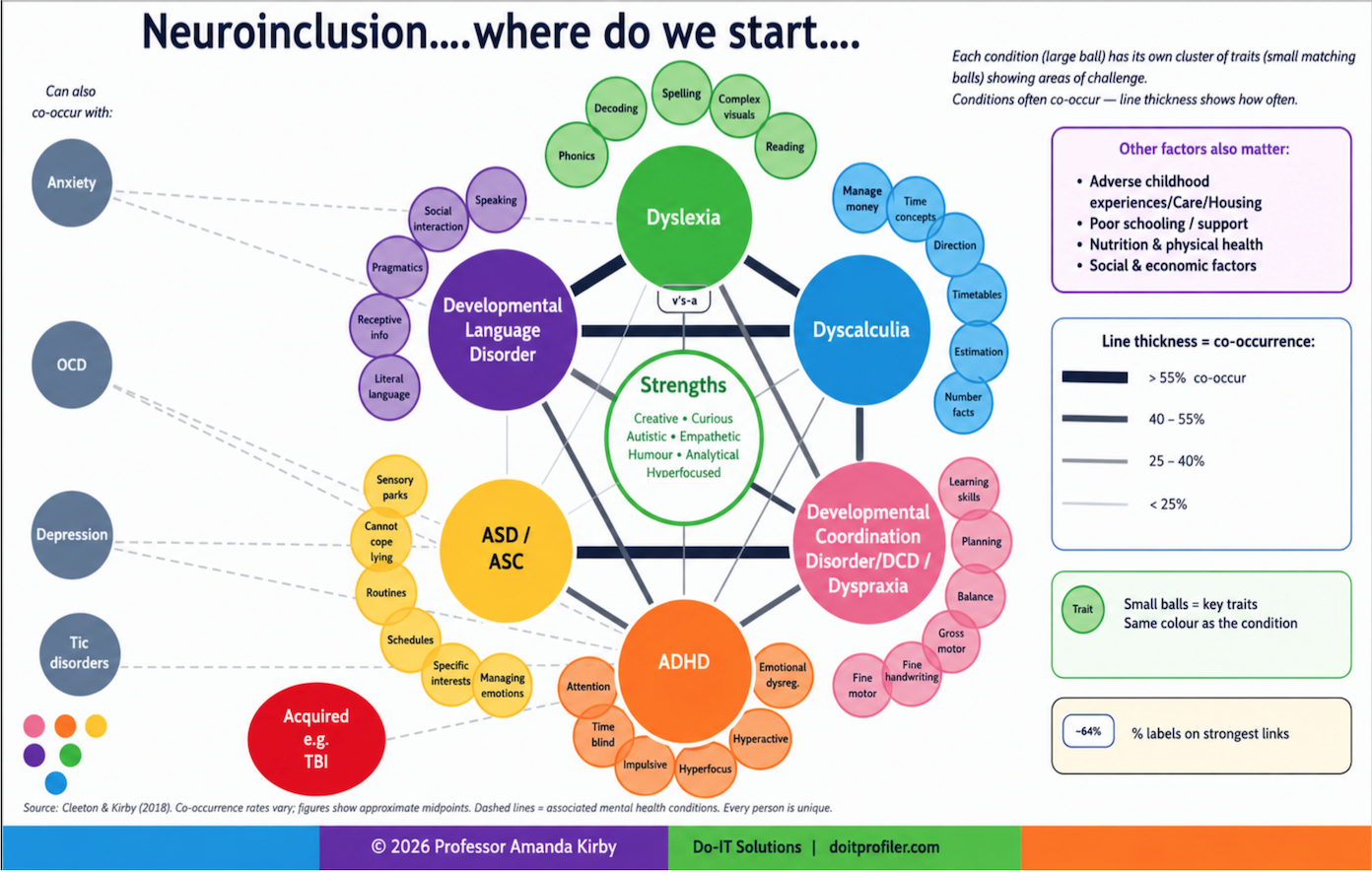
Professor Amanda Kirby’s Neurodiversity Co-occurrence Map (2026) illustrates how neurodivergent traits and conditions frequently overlap rather than fitting into separate diagnostic categories.
Understanding neurodivergent traits at work matters enormously for employers.
A worker is not simply “an ADHD employee”, “an autistic employee”, “a dyslexic employee” or “a person with sensory issues”. They are a whole person with their own pattern of strengths, barriers, sensory experiences, communication preferences, emotional regulation needs, work history, culture, role demands, fatigue profile, relationships and workplace context.
The same trait may appear across different neurodivergent profiles. Sensory sensitivity, executive functioning differences, emotional regulation differences, social communication differences, fatigue, anxiety, rejection sensitivity, justice sensitivity or difficulty describing internal experiences may occur in different combinations for different people.
This is why asking, “What adjustment do we give someone with this diagnosis?” is too narrow.
A better question is “What does this person need, in this job, in this environment, to work safely and well?”
That is the foundation of a person-centred approach. It recognises each neurodivergent employee’s unique way of working, processing and communicating, and designs work and supports around the person rather than forcing the person to adapt to rigid systems.
The Neurodiversity Workplace Profiler, which the Neurodiverse Safe Work Initiative has brought into Australia and adapted to the Australian context for use within our Coaching Programs, reflects this approach by focusing on the individual’s unique neurodivergent profile including their strengths, communication preferences, sensory sensitivities, attention and processing needs, supervision and feedback preferences, wellbeing and safety strategies, functioning, environmental fit and strength-based support rather than just a clinical diagnosis alone.
Every brain is different. Neuroinclusive work design starts there.
Why neurodivergent traits at work are a work health and safety issue
In employment neurodiversity is often framed as a diversity, equity and inclusion issue and managed through the disability discrimination and reasonable adjustments processes.
Those frameworks are important, but they are not enough.
In Australia, the person conducting a business or undertaking (PCBU) (employers) have the primary duty of care to ensure, so far as is reasonably practicable, the health and safety of workers. That includes providing and maintaining a work environment without risks to physical and psychological health and safety. (Comcare)
Safe Work Australia also makes clear that PCBUs must manage psychosocial hazards at work, and that these hazards can cause psychological and physical harm. (Safe Work Australia)
For neurodivergent workers, psychosocial and physical risks may arise when work systems do not account for differences in sensory processing, communication, executive functioning, emotional regulation, fatigue, social expectations, uncertainty, change, feedback, workload, performance management or environmental demands.
The Neurodiverse Safe Work approach is proactive. It asks employers to adapt health and safety management systems to accommodate the different ways workers think, learn, process and retain information, regulate emotions and attention, perceive and respond to risk, and experience the physical environment.
Neurodivergent traits at work: Synaesthesia and sensory experiences
Synaesthesia is a perceptual experience where one sensory or cognitive pathway automatically evokes another. A person may see colours when hearing music, associate numbers or letters with colours, experience tastes linked to words, or perceive days, months or time spatially. Cleveland Clinic describes synesthesia as the brain routing sensory information through multiple unrelated senses, such as tasting words or linking colours to numbers and letters. (Cleveland Clinic)
At work, synaesthesia can be a strength. Some syntesthetes may have strong memory associations, rich sensory thinking, creative pattern recognition, musical or visual strengths, or distinctive ways of organising information.
But it can also create overload. A visually cluttered spreadsheet, clashing colour-coding, inconsistent branding, alarms, background music, harsh lighting, or busy open-plan environments may be distracting, unpleasant or exhausting.
Employers and colleagues can help by providing information in more than one format, using consistent visual systems, avoiding unnecessary sensory clutter, checking whether colours, sounds or visual layouts are helpful or unhelpful, and respecting that perception is real even when others do not share it
Neurodivergent traits at work: Misophonia and workplace triggers
Misophonia is much more than disliking a particular sound. A 2022 consensus definition describes misophonia as decreased tolerance to specific sounds or stimuli associated with those sounds, where triggers are experienced as unpleasant or distressing and can evoke strong emotional, physiological or behavioural responses. (PMC)
At work, triggers may include chewing, sniffing, tapping, keyboard noise, pen clicking, loud breathing, repetitive notification sounds, cutlery, machinery, or certain voices or speech patterns. The volume of the sound is not always the issue. The pattern, meaning, predictability and lack of control may matter more.
Misophonia can be particularly challenging in open-plan offices, shared lunch spaces, meeting rooms, vehicles, call centres and hot-desking environments.
Support may include quiet zones, predictable seating, access to low-stimulation spaces, flexible work locations, permission to use headphones or sound-masking options, and team agreements about avoidable repetitive noise. The goal is not to shame the person for their response. The safe question to ask is “what can we change in the environment to reduce the trigger?”
Neurodivergent traits at work: Rejection sensitivity and feedback
Many neurodivergent adults, particularly people with ADHD, describe intense emotional responses to perceived criticism, rejection, exclusion, disapproval or failure. The term rejection sensitive dysphoria is widely used in lived-experience communities, although it is not currently a formal diagnosis. Recent lived-experience research notes that the term has gained popularity but that there remains a lack of consensus in definition and application across medical, academic and informal settings. (Sage Journals)
At work, rejection sensitivity may show up as distress after feedback, avoidance of performance conversations, over-apologising, people-pleasing, perfectionism, withdrawal after a difficult interaction, or strong reactions to ambiguous messages.
It is easily misread as defensiveness, immaturity or poor resilience. But when feedback systems are vague, infrequent, public, punitive or inconsistent, they can create real psychosocial risk.
Managers can help by providing feedback that is regular, private, specific, behaviour-based and strengths-informed. Do not save feedback for annual performance reviews or only raise issues when something has gone wrong. Use clear language. Explain what happened, what is needed, what support is available and what success looks like.
Neuroinclusive performance management focuses on strengths and outcomes, recognises that different does not mean deficient, uses clear and specific language, provides regular supportive feedback, and asks “How can I help you succeed?”
Neurodivergent traits at work: Justice sensitivity in workplaces
Justice sensitivity refers to a heightened awareness of fairness, unfairness, inconsistency or harm. Research has found justice sensitivity to be more pronounced in people with ADHD, particularly the inattentive subtype. (PubMed)
In workplaces, justice sensitivity can be a significant asset. Workers with strong justice sensitivity may notice unsafe practices, policy inconsistencies, inequity, bullying, exclusion, ethical risks or unfair treatment before others do. They may be persistent advocates for safer and more accountable systems.
The challenge arises when workplaces interpret this as being difficult, oppositional or disruptive. A worker who repeatedly raises concerns about fairness may be identifying a psychosocial hazard that others have normalised.
Employers can support justice-sensitive workers by explaining decisions transparently, applying policies consistently, creating safe reporting pathways, inviting constructive challenge and feedback, and ensuring that speaking up does not lead to retaliation.
Poor organisational justice is itself recognised by Safe Work Australia as a psychosocial hazard that can cause psychological and physical harm. (Safe Work Australia)
Neurodivergent traits at work: Alexithymia and emotional processing
Alexithymia refers to difficulty identifying, describing or reflecting on one’s own emotions. It commonly co-occurs with autism, but it is not exclusive to autistic people. A systematic review and meta-analysis found that alexithymia is frequently associated with autism and may explain some emotion-processing differences that have previously been attributed to autism itself. (PMC)
At work, alexithymia can affect wellbeing conversations, conflict resolution, supervision, performance discussions and incident investigations. A worker may not be able to answer, “How are you feeling?” or “Why did that upset you?” in the moment, and the question “Are you Ok?” on Are You OK Day while well intentioned and well received by many can be particularly perplexing for workers who experience alexithymia.
They may notice physical signs first. A headache, nausea, emotional shutdown, fatigue, tears, restlessness, muscle tension or irritability. They may need time, written prompts or concrete questions to understand what is happening internally.
Supportive questions might include:
- “What are you noticing in your body?”
- “Is this task clear or unclear?”
- “Is the pace manageable?”
- “Do you need time before we talk?”
- “Would it help to write this down first?”
- “Is there something about the environment, workload or communication that is creating pressure for you?”
This is not about avoiding emotions. It is about making emotional communication psychologically safe and clearer.
Neurodivergent traits at work: aphantasia and hyperphantasia
Aphantasia refers to absent or markedly reduced voluntary mental imagery. Hyperphantasia refers to unusually vivid mental imagery. A 2024 large-scale study estimated prevalence at approximately 1.2% for aphantasia and 5.9% for hyperphantasia in one international sample, with similar estimates when combined with other datasets. (Frontiers)
These differences can matter at work more than people realise.
Training, coaching and communication often assume that everyone can “picture this”, “visualise success”, “imagine the customer journey” or “see the end result”. For someone with aphantasia, that mental image may not exist. But that does not mean they lack imagination. They may think powerfully in words, concepts, systems, logic, facts or spatial relationships.
For someone with hyperphantasia, imagery may be vivid, immersive and creative. It may support design, storytelling, planning, empathy and problem-solving. But it may also become overwhelming, especially in roles involving distressing material, conflict, risk scenarios, traumatic content or intrusive memories.
Employers can help by offering multiple ways to process and remember information such as written steps, diagrams, flowcharts, mind maps, templates, examples, demonstrations, checklists, models, verbal explanation and practical walkthroughs.
Do not assume visualisation is universal.
Neurodivergent traits at work: Prosopagnosia in workplace settings
Prosopagnosia, often called face blindness, affects a person’s ability to recognise faces. At work, this can be mistaken for rudeness, disinterest or lack of professionalism when a worker does not recognise a colleague, client or stakeholder.
Face Blind UK notes that practical supports can include clear name badges, attendee lists and introductions in discussion groups. (faceblind.org.uk).
Prosopagnosia can affect networking, customer service, security, conferences, meetings, team relationships and informal social connection. A person may recognise others by voice, hairstyle, clothing, gait, location, role, context or name badge rather than by face. If someone changes their hair, uniform, glasses or usual setting, recognition may fail.
Workplaces can help by using name badges, clear introductions, meeting attendee lists, photos in directories, predictable seating, and online meeting practices where speakers identify themselves. Colleagues should avoid testing recognition with comments such as “Do you remember me?” or “Surely you know who I am?”
The person is not being rude. Their recognition system works differently.
The double-empathy problem at work – communication goes both ways
The double-empathy problem reframes communication breakdowns between autistic and non-autistic people. Rather than assuming autistic people lack empathy or social understanding, it recognises that people with different neurotypes may misunderstand each other. Damian Milton’s original theory describes a disjuncture in reciprocity between differently disposed social actors, which becomes more marked as differences increase. (Taylor & Francis Online)
This is highly relevant to work.
Many workplace norms are unwritten. How much eye contact is expected, when to make small talk, how quickly to respond, how directly to speak, how to show interest, when to challenge, how to interpret silence, and how to read tone.
Autistic communication may be direct, detailed, honest, written, literal, interest-led or less reliant on facial expression. Non-autistic colleagues may misread this as blunt, disengaged or lacking warmth. Autistic workers may equally find neurotypical communication indirect, inconsistent, confusing or unsafe.
The solution is not to train autistic workers to perform neurotypical communication at all costs. That can increase masking, fatigue and psychological risk. Safer practice requires mutual adaptation.
Use written follow-up. Ask about communication styles and preferences. Avoid relying on hints. Make expectations explicit. Clarify rather than assume. Teach all workers that different communication is not inadequate communication.
Neuroinclusive hiring practices also need to reflect this. Requirements such as “must have excellent communication skills” can be vague and biased against neurodivergent applicants, particularly those with atypical speech, tone, social interaction styles or a preference for written communication. A better approach is to describe the actual communication required for the role and allow people to use preferred formats where possible.
What employers and colleagues need to know
The most important message is that neurodivergent traits at work are not rare curiosities.They are part of human variation.
They do not sit neatly inside one diagnosis. They may overlap. They may interact. They may be present in diagnosed, undiagnosed and self-identified neurodivergent workers. Some people will identify strongly with one trait but not with a broader label. Others may have several traits that affect each other in different contexts.
That is why neuroinclusive workplaces cannot rely on labels alone.
A label may be useful, but it is not a complete map of a person’s needs. A diagnosis does not tell you exactly how a worker experiences noise, feedback, injustice, faces, visual imagery, communication, fatigue, uncertainty, emotions or sensory environments in a specific job.
A person-centred approach asks better questions:
- What are this person’s strengths?
- What barriers are they facing in this context?
- What does the work require?
- What features of the environment increase risk?
- What helps this person work safely and well?
- What can we change in the system, rather than expecting the person to carry the whole burden?
This is also why workers need psychologically safe ways to talk about how they work. Many neurodivergent workers do not disclose because they fear discrimination, stigma, disbelief or career consequences. Usually with good reason. Most have had witnessed or experienced negative experiences in the past. When systems and cultures are not inclusive, workers may struggle silently until issues are misinterpreted as performance, conduct or attitude problems.
Practical ways to create a neuroinclusive workplace
Supporting neurodivergent traits at work does not require every manager to become an expert. It requires curiosity, consultation, respect for difference, and a willingness to design work for real human variation.
Employers and teams can start with these actions.
Design for difference from the beginning
Build flexibility into communication, meetings, training, work environments, recruitment, supervision, feedback and performance systems.
Consult workers about what helps
Safe Work Australia’s model code of practice states that workers must be consulted at each step of the risk management process, including identifying and assessing psychosocial hazards, when they are, or are likely to be, directly affected by a WHS matter. (Safe Work Australia)
Focus on functioning, not labels
Ask what the person needs to work safely and well. Do not require workers to educate everyone about their diagnosis before support is considered.
Reframe “reasonable adjustments” as risk management controls
Written instructions, quiet spaces, flexible work arrangements, name badges, sensory-aware environments, regular feedback and clear expectations should not be treated as special favours.
Train managers and teams
Many risks arise from misunderstanding, stigma, rigid systems or poor communication. Training should help people understand neurodivergent functioning, psychosocial hazards and inclusive work design.
Review policies for unintended harm
A policy is not inclusive simply because it is applied equally to everyone. Equal treatment can still create inequitable and unsafe outcomes. As we often say at Neurodiverse Safe Work: no policy is inclusive if it causes harm.
Use person-centred tools
Tools such as the Neurodiversity Workplace Profiler can support structured, confidential and practical conversations about communication, sensory needs, attention, processing, feedback, supervision, wellbeing and safety. The aim is not to fix people. It is to design work with them, not just for them.
A safer way forward
Neurodivergent workers bring creativity, precision, pattern recognition, empathy, ethical awareness, sensory insight, innovation, persistence and resilience. But these strengths are most likely to emerge when workplaces remove unnecessary barriers.
As we mark International Synesthesia Day on 2 July, it is worth remembering that many people experience the world in ways others cannot see.
- Some hear colour.
- Some experience sound as threat.
- Some cannot picture an image.
- Some see images too vividly.
- Some cannot recognise faces.
- Some cannot easily name emotions.
- Some feel injustice intensely.
- Some experience feedback as danger.
- Some communicate across a neurotype divide every day.
Creating workplaces that support neurodivergent traits at work is not about memorising every trait. It is about recognising that every brain is different and designing work accordingly. When employers consciously include, they reduce the risk of unconscious exclusion. And when workplaces are designed for the real diversity of human minds, everyone is safer.
Join us on 2 July for our International Synesthesia Day webinar with Professor Amanda Kirby and Celia Craig, where we’ll explore lesser-known neurodivergent traits, including synaesthesia, and discuss practical strategies for creating safer, more neuroinclusive workplaces.
Whether you are a leader, HR professional, WHS practitioner or employer, this session will provide practical insights into person-centred approaches that move beyond labels and support safer work design.
Register here to learn how to design work for every brain.